
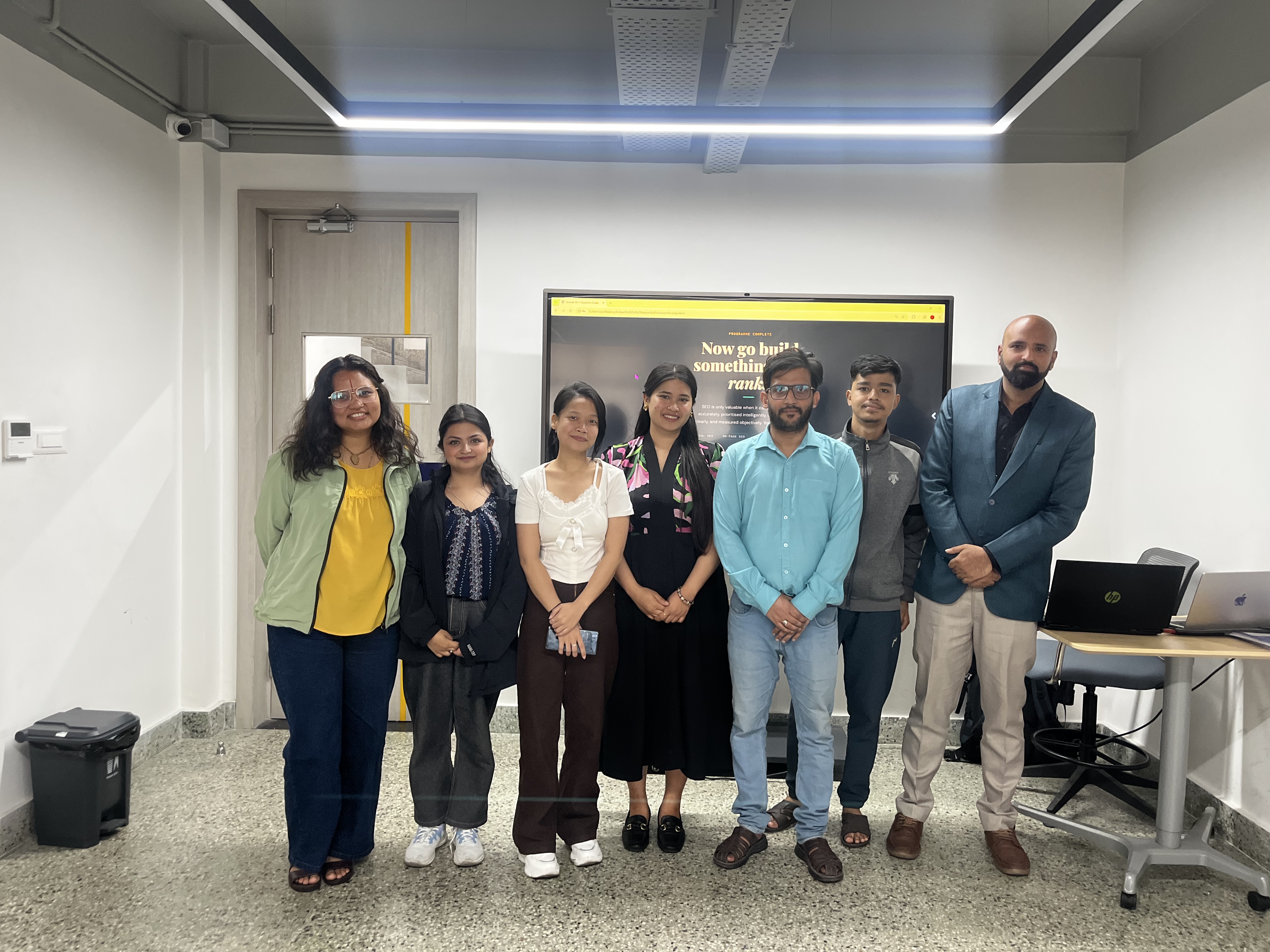
We are proud to share that Infinity Digital Agency (IDA) has successfully concluded its inaugural SEO, GEO & AEO Fundamentals Programme, delivered in partnership with Embark College. The ten-session, 20-hour course brought together professionals from across the digital and communications sectors for a deep, practical dive into modern search: traditional search engine optimisation, generative engine optimisation, and answer engine optimisation across all three retrieval surfaces.
The programme was led by our own Ms. Sabiya Shah, General Manager at Infinity Digital Agency, and Mr. Abnish Jha, SEO Team Lead at Infinity Digital Agency. Both instructors designed and delivered the curriculum from the ground up, drawing directly from the strategies and processes we use in our day-to-day client work. As a digital marketing company in Nepal, we wanted the course to reflect the real problems our team solves every day, not a syllabus assembled from generic theory. That is what participants got.
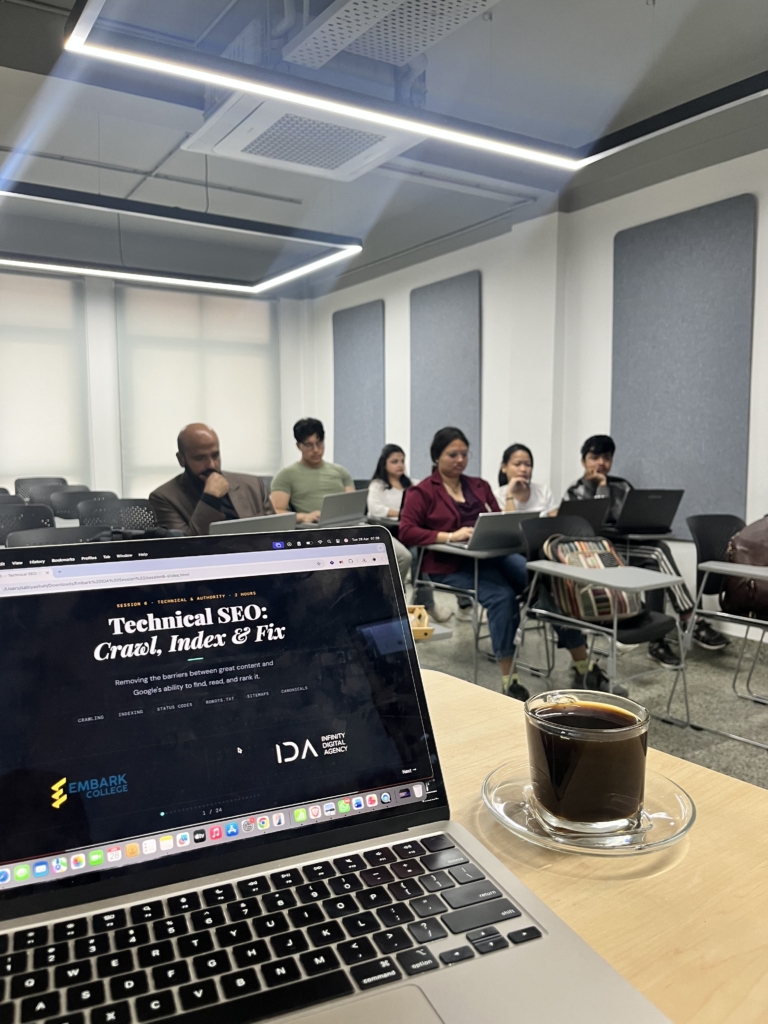
Most participants were already working in SEO, digital marketing, content, or closely related fields. They brought real-world experience into the room, and our goal was to give them the structured framework and technical depth to make that experience go further. Watching that happen over ten sessions was genuinely satisfying.
The programme covered every layer of modern search, and each session’s output fed directly into the next. Here is what the ten sessions covered:
Session 1: The Search Landscape
- How crawling, indexing, and ranking actually work
- The three search surfaces: traditional organic results (SEO), AI-generated answer panels (GEO), and direct answer extraction including featured snippets and People Also Ask (AEO)
- The four search intent types and how to match them to content formats
- Live SERP teardown using participant sites to identify gaps in visibility
- Google Search Console setup and reading baseline metrics
Session 2: Keyword Research & Intent Modelling
- Building seed keyword lists from audience needs, not tool suggestions
- Mapping search intent across the AIDA funnel: awareness, interest, desire, action
- Expanding seed keywords using Semrush, Google Keyword Planner, and Google Trends
- Clustering keywords by topic and intent to avoid cannibalisation
- Producing a 30-keyword cluster list with assigned page types and user problems
Session 3: Content Planning & Topic Authority
- Reverse-engineering top-ranking pages to understand what satisfies a given search intent
- Building pillar pages and supporting article clusters using the hub-and-spoke model
- Mining People Also Ask questions using AlsoAsked.com for content structure
- Identifying competitor content gaps through manual analysis
- Assigning content formats (guide, comparison, FAQ, service page) based on SERP evidence
Session 4: Information Architecture & Internal Linking
- How internal link equity flows across a site and why it matters for rankings
- Designing hub-and-spoke architecture for both content and e-commerce sites
- Live Screaming Frog audit to identify orphaned pages and underlinked content
- Writing contextual anchor text that signals topic relevance without over-optimising
- Breadcrumb navigation as an SEO asset and its dual benefit for crawling and structured data
Session 5: On-Page SEO & E-E-A-T
- Writing title tags that are keyword-first, under 60 characters, and click-worthy
- Meta descriptions as ad copy: benefit-led, with a soft call to action
- Structuring headings as a semantic outline for both Google and featured snippet extraction
- Applying E-E-A-T through author bylines, cited sources, updated dates, and trust signals
- Image SEO: descriptive file names, accurate alt text, and compressed file sizes
Session 6: Technical SEO: Crawlability & Indexing
- The crawl-index-rank pipeline and how each technical issue fits into it
- Reading and configuring robots.txt correctly, including common mistakes that block rendering
- Building and submitting an XML sitemap that only includes indexable pages
- Canonical tags and 301 redirects: when to use each and what happens when you get it wrong
- Live Screaming Frog audit producing a prioritised issue list rated by impact and fix effort
Session 7: Performance, Core Web Vitals & Reporting
- LCP, INP, and CLS: what each measures and what the good thresholds are
- Running PageSpeed Insights and tracing the top three recommendations to specific files
- Mobile-first indexing: why Google’s entire view of a site comes from its mobile version
- Building a Looker Studio SEO dashboard connected to Google Search Console
- The difference between vanity metrics and the metric chain that actually shows SEO ROI
Session 8: Off-Page SEO & Digital PR
- Assessing backlink quality by topical relevance, page quality, and link placement
- Live competitor backlink analysis to identify outreach opportunities and link patterns
- What a linkable asset is and which formats earn inbound links without one-to-one outreach
- The difference between digital PR and generic link building, with a real pitch example
- Writing personalised outreach emails using Hunter.io, with peer review of drafts
Session 9: AEO + GEO Implementation Lab
- The five content structures that consistently earn featured snippets: definition blocks, numbered step lists, comparison tables, FAQ sections, and concise direct answers
- Writing FAQPage and HowTo schema markup and validating with Google Rich Results Test
- The five criteria AI systems use when deciding whether to cite a source
- Entity-first writing: naming things explicitly so search engines and AI systems can extract meaning
- Tracking AI visibility through Bing Webmaster Tools and manual testing in Perplexity
Session 10: Capstone Studio
- A one-page site audit summary written in business language, not technical jargon
- A keyword opportunity map covering prioritised clusters by traffic opportunity and difficulty
- A 90-day optimisation roadmap sequenced correctly: technical fixes first, then on-page, then new content, then outreach
- One fully optimised content piece demonstrating every technique from sessions 3 through 9
- A 30-day action plan with week-by-week tasks and a single success metric per week
Each participant completed the programme with a full, client-ready SEO strategy document built from their own research and work across every session.
The state of SEO in Nepal is changing fast. AI search surfaces are reshaping how content gets discovered, and the professionals who understand how traditional SEO, GEO, and AEO work together are the ones who will stay ahead of it. Building a course that addressed all three surfaces, from the ground up, for professionals already in the industry, was something we had not seen done here before. We are glad we did it.
This is only the beginning. We are excited to continue the SEO, GEO & AEO Fundamentals Programme with future cohorts, and we are actively planning a broader range of digital media and marketing courses to follow. If you are interested in upskilling yourself or your team, we would love to hear from you.